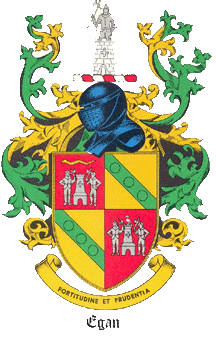
The Gaelic legal tradition of the derbhfine is well understood. It limited leadership to a kinship group within four generations of a common great-grandfather. This was a deliberate design. It produced local, accountable, short-term leadership, and it prevented any single branch from permanently dominating the others.
The MacAodhagáin (Egan) family was never a single political unit, and it never had a paramount leader. Different branches served as hereditary brehons to different lords in different territories — the O'Kennedys in Ormond, the O'Connors in Tethbae, the Burkes in Connacht, and others. Each branch had its own derbhfine, its own lands, and its own loyalties. None owed allegiance to any other. Recognition among the branches was a matter of local standing and reputation, not of over-lordship.
A derbhfine, by its own rules, extends only four generations. It cannot, by definition, claim authority over a family group that separated from its lineage centuries ago. To do so is to disregard the very tradition being invoked. The derbhfine was constructed precisely to prevent the rise of a supreme chief; a paramount claim over the whole family therefore contradicts the very system it claims to rest on.
The Republic of Ireland does not recognise titles of nobility. The state's courtesy recognition of "Chiefs of the Name" was abandoned in 2003. No legal authority exists to confer paramount status over a worldwide diaspora.
The Egans' historical significance lies in their legal scholarship and their service as brehons, not in feudal titles or in claims to overarching authority.
Within the wider Egan family there are many distinct family groups, each with its own history and its own derbhfine. These groups are independent of one another.
Clann Mac Aodhagáin therefore recognises the historical reality of multiple independent family groups, united by shared heritage and mutual respect, not by fealty to any individual or branch.
Clan Egan today is inclusive and forward-looking. Membership is open to all who bear the name or trace descent from the family, without regard to lineage, branch, or geography. Our relevance in a modern world rests not on claims to past authority but on shared heritage, scholarship, and community — values that unite us across the family's many independent groups.
Supporting attachment: Statement of Purpose of the Clann, as submitted to the Australian Taxation Office, confirming the Clann is a voluntary not-for-profit heritage association.
August 2026