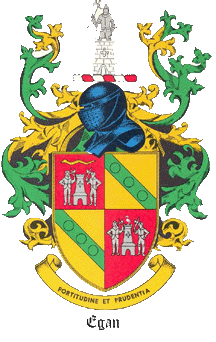
Uniquely among Irish families the MacEgans were distinguished for learning rather than military prowess. Over five centuries they became Ireland's most learned literary family, leaving an enormous body of medieval Irish and Latin writing. The great codices — the Book of Duniry (Leabhar Breac), the Book of Ballymote, and the Book of the Dun Cow (Leabhar na hUidre), which they preserved and transmitted — are associated with them.
To Mícheál Ó Cléirigh, principal author of the Annals of the Four Masters, Baothghalach Ruadh MacAodhagáin was "the most learned Irishman that ever lived." When the Annals were compiled in 1636, Ó Cléirigh sought approbation from six of the most learned men in the country; the first was Flann MacAodhagáin of Ballymacegan and Redwood Castle, while Baothghalach MacAodhagáin, Bishop of Elphin, was third on the list.
The Brehon (Judge) and Ollave (Professor) ranked among the highest in Irish society, and the MacEgans were the outstanding hereditary holders of these offices. Throughout the annals numerous family members are recorded for their achievements in this field. As brehons and ollaves they became attached to many Irish territories, and later when the Normans adopted Irish language, law, and custom, MacEgan brehons were retained by them — notably the Burkes of Clanricarde and the O'Kennedys of Ormond.
The family belonged to the Uí Maine dynasty, a kingdom spanning east Galway and south Roscommon, and traced their descent from Cairbre Crom, a 6th-century chief of Hy Many, with their eponymous ancestor Aodhagáin flourishing in the 10th century — making the surname one of the oldest hereditary surnames in Europe. The name derives from the root aedh (fire) and the diminutive an — "the little bright-eyed one."
Rising to prominence in Uí Maine as hereditary brehons to the Ó Ceallaigh (O'Kellys), the Egans established their first centres of learning at Park and Duniry in County Galway. From this heartland they spread their influence across Ireland, establishing major branches in Ormond (Tipperary), Clanricarde (Galway), Tethbae (Westmeath/Offaly), and south Connacht (Sligo/Mayo). In time they served as ollamh to the Ó Conchobair Kings of Connacht, the Ó Fearghail of Annaly, the Ó Conchobhair Uí Failghe of Offaly, and the Mac Geoghegan of Tethbae. Their network of schools and landed estates made them the most widely distributed brehon family in Gaelic Ireland.
Egans ran renowned schools of law and poetry at Park and Duniry in County Galway, at Ballymacegan/Redwood Castle in County Tipperary, and at other sites associated with their septs. Redwood Castle, acquired c.1350, became a principal seat of the Ormond branch and housed a law school that flourished into the mid-17th century. The Park school, in O'Kelly territory, was likely the earliest and produced scribes who compiled some of Ireland's most important legal manuscripts, including In Senchas Már (c.1350) and portions of the Book of Ballymote. These schools taught not only brehon law but also Latin, metric poetry, history, and genealogy, maintaining the full curriculum of the filid (learned class).
A grave slab at Fuerty, Roscommon, dated 869 A.D., is traditionally believed to mark the resting place of the progenitor Aodhagáin, an anchorite of Clonmacnoise. The Annals record his death in 865 A.D. and note his ecclesiastical role at Clonmacnoise, Ireland's premier monastic university, where the family likely received their foundational education in canon and brehon law. Beyond a wealth of legal and historical manuscripts, the Egans' legacy includes works of distinguished craftsmen and artists. Mael Isu MacEgan is traditionally credited with creating the famous Cross of Cong in 1123 at the request of the Bishop of Elphin; he is also suggested as the maker of Saint Manchan's Shrine, a reliquary of the same period. Both pieces rank among the finest survivals of Irish Romanesque metalwork.
The family's influence endured the transition from Gaelic to English law. Egans served as judges, lawyers, and administrators under the new order, with branches conforming to the Crown in the 16th–17th centuries while others remained active in Confederate and Jacobite causes. Like other Irish families who did not conform, they lost their lands but preserved the educational tradition throughout the Penal Times. After Emancipation in 1829 many of the name followed their hereditary professions of teaching, law, and medicine. Redwood Castle was restored in the 20th century and remains a focal point for the clan. Today the MacAodhagáin comprise multiple independent family groups — in Ireland, Britain, Australia, the Americas, and beyond — each with its own history and leadership. Some groups recognise a chief or convenor through private derbhfine election or peer recognition; others operate as voluntary heritage associations. No single paramount chief exists or can exist under historical Gaelic law or modern Irish law. The clan's unity rests on shared heritage, scholarship, and community rather than feudal allegiance.
This is the official site of the Australian
& New Zealand Clann Mac Aodhagáin Association
The Clann is an independent association in
its own right, and maintains friendly relations with the Egan family
associations of North America and
Ireland.
The Clann
welcomes all who share the name or a genuine interest in its heritage, in
the inclusive spirit the Egans have always practised through their
associations. Members and non-members alike are welcome.
Clan Egan today is inclusive and forward-looking. Membership is open to all who
bear the name or trace descent from the family, without regard to lineage, branch,
or geography. Our relevance in a modern world rests not on claims to past authority
but on shared heritage, scholarship, and community — values that unite us
across the family's many independent groups.
The Clann is a
voluntary not-for-profit association. Its Statement of Purpose, as
submitted to the Australian Taxation Office, is available
here.
Last updated August 2026.